 English
 Bahasa Indonesia
Gedung Kuliah I (GK I) FBS UNY
Jl. Colombo No. 1 Yogyakarta 55281
Telp. (0274) 550843, 546719, Fax (0274) 548207
Website: sasing.fbs.uny.ac.id
Email: sastrainggris@uny.ac.id
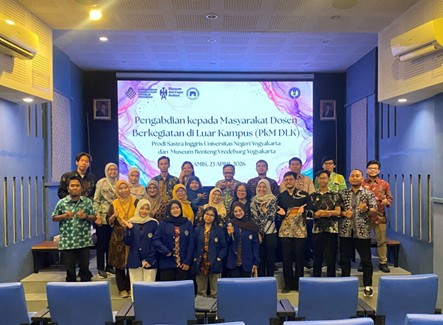
English Literature Study Program of UNY held a social media optimization training to improve museum function and branding for museum managers in Yogyakarta on Thursday, April 23, 2026. This activity is a Community Service (PkM) activity carried out by the PkM team led by Prof. Erna Andriyanti, Ph.D. In its implementation, this activity focuses on the application of copywriting and content writing strategies to improve branding and museum visits.
In the Audio Visual Room of Vredeburg Fort Museum, the event was opened by Dr. Rachmat Nurcahyo, M.A., the Coordinator of the English Literature Study Program at UNY. He stated that this activity is a means of disseminating knowledge that is beneficial to the community. Agus Sulistyo, M.A., Head of Vredeburg Fort Museum, welcomed the trainees and hoped that the networking would continue in the future.
The training, themed "Optimizing the Use of Social Media to Strengthen the Function and Branding of Government Museums in Yogyakarta," involved representatives from approximately 25 museums in Yogyakarta. The participating museums included MBVY, Sonobudoyo Museum, Sandi Museum, Taman Pintar, Gadjah Mada University Biology Museum, Indonesian Education Museum, and Kotagede Museum.
The initial training session began with a presentation entitled "Optimizing Content and Copywriting to Strengthen the Function and Branding of Museums." This material was presented by the Head of the PkM Team, Prof. Erna Andriyanti, Ph.D. In her presentation, Prof. Erna explained two different communication instruments: content writing and copywriting. The fundamental difference between the two lies in their objectives: content writing aims to educate and entertain or provide benefits, while copywriting is used to encourage audiences to take action. Specifically in the museum context, increasing visitor numbers can be one of the targets achieved through both methods.
Prof. Erna added that museums need to build brand awareness by consistently displaying their logos and slogans in social media posts. These two elements serve to demonstrate the museum's identity, convey its message and vision, build emotional connection with the public, and echo the values of cultural preservation, education, and inspiration. To ensure these efforts are accepted by the audience, a content marketing strategy is the most appropriate choice due to its natural, economical nature, and its ability to have a significant impact. When marketing content, museums need to maintain a balance between the quantity and quality of their social media posts.
In the next session, Susana Widyastuti, Ph.D., presented on Copywriting Strategy for Museum Content. She encouraged participants to evaluate their respective museums' social media platforms to understand their content needs and objectives. Given the educational and conservation functions of museums, effective content is not simply about selling; it must be presented to the audience with the appropriate purpose and channel.
Generally, the structure of a copy consists of an attention-grabbing headline, body copy, and a call to action (CTA). Strategically, copywriting can employ either a hard-selling or soft-selling approach. Content creators can utilize three formulas: AIDA (attention-interest-desire-action), PAS (problem-agitate-solve), and BAB (before-after-bridge). At the end of her presentation, Susana emphasized that the right combination of structure, purpose, and strategy in content creation will produce valuable work.
The session continued with a practical session, lasting approximately three hours. Participants were divided into groups based on their respective institutions and tasked with creating a concise piece of content to be uploaded to their respective institutions' social media channels. The discussion was lively and engaging, with participants exchanging ideas on content and presentation methods. Toward the end of the practical session, each group was asked to present their work and received feedback from the other groups and the PkM team.
The training concluded with an evaluation. Survey results distributed to participants indicated high appreciation for the competence of the speakers, the relevance of the material, its benefits, and the organization. Overall, participants found the activity highly beneficial, providing them with the knowledge and practical skills they need to manage their respective institutions' social media channels. Therefore, it is highly recommended that similar activities be held againto expand the collaboration between the UNY English Literature Study Program and more museum partners. (Ts)